

It may be said that a D&O risk professional’s day is like that of an anesthesiologist’s— a hypervigilant routine providing high-stakes stability and crisis prevention punctuated by periods of preternatural calm in the face of sheer terror.
An observant D&O risk professional may have noticed a new potential threat to good governance: reputation risk. Weaponized by social, political, and investor activists and litigators, it is becoming a coercive force that is leaving impugned directors and officers facing genuinely impaired careers and prospects; i.e., professional disability.
Whether the risk to an officer or director is an insignificant 5% professional impairment or complete career untouchability after a major corporate crisis, corporate secretaries, governance consultants, and other governance stakeholders should at least consider enhanced governance, communications, and insurance strategies to protect leadership resilience.
For the professional liability underwriting community, it is particularly noteworthy that D&O liability insurance—the governance safety net predecessors fought to establish forty years ago—does not respond to D&O professional disability. D&O reputation insurance does.
Signs of Coercion
When threats emerge to directors, officers, or the integrity of the boardroom itself, the D&O risk professional is among the first to recognize them and may be the first expected to act. Like some other challenges to enterprise value and its leadership, reputation risk appears to have been emerging two ways: slowly and now suddenly. Among the signs:
- decreased diversity in director demographics;
- increased personal executive disparagement in social media;
- increased references to D&O reputation risk on the internet; and
- surging internet searches for reputation insurance
- novel endorsements for reputation insurance from legal and governance authorities.
Director Diversity is Decreasing
Directors with diverse1 backgrounds are not being placed: Appointments of first-time directors in 2025 who self-identify as underrepresented minorities declined by 38% from 2024. Diverse directors including women in the new S&P 500 class declined by 22% from 2024, according to board advisor Spencer Stuart. They reportedly are declining opportunities at risk for drawing the attention of activists. These choices are influenced by the knowledge that according to Bloomberg, 45 companies with a combined market value of almost $10 trillion that have been attacked for their DEI efforts in the past three years.
Personal Public Disparagement is Increasing
Corporate director disparagement is surging on the internet, with the important distinction that language is shifting from questioning the quality of their work product to questioning their personal character. Crude disparaging terms such as jerk and asshole on pages with the words board member director have surged on internet pages by factors of 1100% and 1600% over the past five years, while the reserved term incompetent has only doubled (Figure 1). Most of the recent surge in disparaging online language—terms like “jerk” and “incompetent”—has occurred over the past two years.
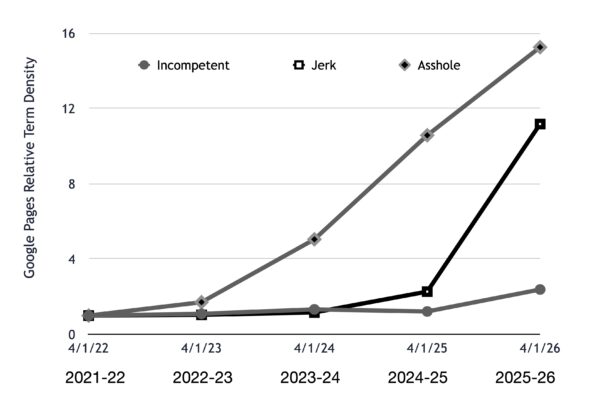
Figure 1. Growth in the relative density of disparaging terms on pages with the words board member director, segmented into 12-month intervals. Source: Steel City Re analysis of Google Search data. Retrieved April 9, 2026.
On the other hand, scatological disparagement is not yet dominant. While such rhetoric adds punch to activist and influencer communications, it supplements rather than replaces traditional critiques. For example, Trian sharply criticized Disney director Maria Elena Lagomasino in 2024 for an alleged history of poor compensation oversight, and in 2025 Askeladden Capital charged in its proxy fight with AstroNova that the “incumbent Board (had) been asleep at the wheel” and “lacked a culture of accountability.” In absolute numbers, in the trailing twelve months from April 2026, incompetent was most prevalent at 18 million pages. Idiot appeared on only 14 million pages, while moron, asshole, and jerk trailed at 5 million, 2 million and almost 1 million pages respectively (Figure 2).
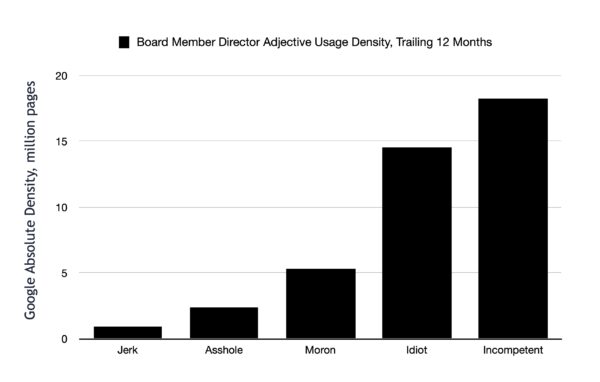
Figure 2. Absolute frequency of the density of disparaging terms associated with the terms board member director in the trailing twelve months from April 2026. Source:Steel City Re analysis of Google Search data. Retrieved April 9, 2026.
D&O Reputation Risk is Increasingly Topical
Internet pages feature the words D&O reputation risk are also growing. While the pace does not match the pace of growth of disparaging language, there is a growing interest in the topic (Figure 3). The term’s appearance has doubled over the past year, and is up 700% over the past five years.
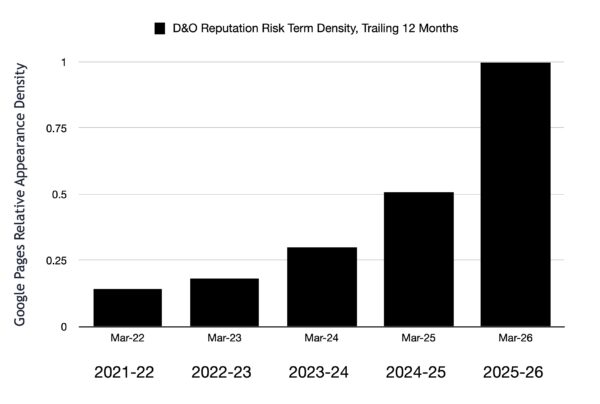
Figure 3. Growth in the relative density of the words D&O reputation risk, segmented into 12-month intervals. Source: Steel City Re analysis of Google Search data. Retrieved April 9, 2026,
Reputation Insurance is Also Increasingly Topical
Internet search interest in reputation insurance has surged after a slow start. In the trailing 12 months from April 1, 2026, internet searches for reputation insurance jumped 1000% over last year. They were 5000% greater than five years ago. (Figure 4)
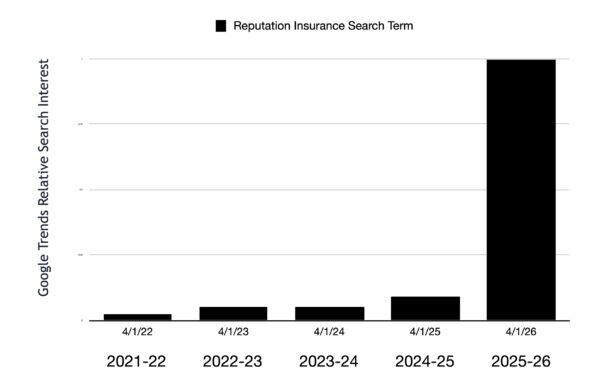
Figure 4. Recent surge in searches for reputation insurance. Relative frequency of searches on the internet for the term reputation insurance presented on a relative scale. The density of searches over the trailing 12 months from April 1, 2026 was 1000% greater than the comparable period in 2024. Data source: Steel City Re analysis of Google Trends data. Retrieved April 9, 2026.
Also worth noting is that in 2025, both the American Law Institute and the Directors and Chief Risk Officers Risk Governance Institute began recommending reputation insurance. The ALI recommendation was embedded within a section addressing compliance strategies—for protecting a firm’s reputation vis-à-vis regulators—in their Principles of the Law, Compliance and Enforcement for Organizations. The DCRO Institute’s recommendation was direct comprising one of the ten points for improving reputation risk governance in their Guiding Principles for Reputation Risk Governance. Essential Principles for Boards of Directors.
Coercion Mitigation Rationale and Options
A D&O risk professional might be motivated to mitigate D&O reputation risk if they reasonably concluded that it materially impacted good governance. They might also be motivated by the personal impact of reputation value loss on an executive, officer, or director. Studies show cascading effects of public leadership humiliation and the loss of prospects. A director who steps down under a spotlight—publicly voted out—will experience a 170% greater loss than otherwise.
“It’s far easier to get another job,” observed rogue trader Nick Leeson. “It’s not so easy to get another reputation.” And as the Financial Times observed some years back, “Corporate names are resilient: when their images get damaged, a change of management or strategy will often revive their fortunes. But personal reputations are fragile: mess with them and it can be fatal.”
Legal & Governance Strategies
Enhance Reputation Risk Governance and Oversight. One strategy employed that is unique to liability risk’s twin has been emphasizing reputation risk governance by formally adding it to a board charter or board committee title. In the past two years, firms as diverse as HSBC, Volkswagen, AstraZeneca, and UnitedHealth Group among others have created a board-level committee to oversee reputation or added “reputation” to an existing committee’s charter. While such strategies have often been rewarded by investors, the individual reputations of board members can benefit from their penumbra.
Compensation Clawbacks. In 2024, DragonGC reported that over 70% of the S&P 500 companies had implemented compensation clawback policies that went beyond the SEC’s basic mandates. American Airlines and US Bancorp were among the 32.9% of companies with policies targeting misconduct that harms the company’s reputation. Boards have begun monitoring reputation value
Communications Strategies
Monitoring Reputation Value. Board advisor Heidrick & Struggles reports that in collaboration with corporate affairs, boards are having reputation metrics included in their ‘enterprise risk management framework.’
Preparing for Personal Sacrifices. A unique feature of reputation risk is that defending or restoring the reputation of a company may have to come at the expense of the reputation of an executive, director, or officer. There is a case to be made that a board should be furnished with its own crisis communications team just as an audit committee is often furnished with its own legal counsel.
Insurance Strategies
Plugging the Coverage Gap of D&O Liability Insurance. D&O liability insurance does not cover reputation loss. It does not respond to going-forward losses from impaired personal reputations adjudicated in the court of public opinion, which is why, as noted above, reputation insurance is recommended by both the American Law Institute and the DCRO Risk Governance Institute
D&O Reputation Insurance. There are non-exclusive insurance strategies to plug the gap. Companies that have insurance captives, and a supportive domicile, may find that vehicle provides a financially attractive approach to cover reputation risk. Both captives and their parents may also find value in D&O reputation insurances that use parametric technology. Astra Zeneca used both strategies to pool reputation risk with supply chain and product recall risks.
Bottom Line
Risk professionals should be alert to the emerging threat of reputation risk and evolving strategies for mitigating it. Some are behaving as if it is already here. Because of unique features of the risk, the legal architecture to enforce rights and the communications infrastructure to manage narratives in real time may require nuanced adjustments. Parametric D&O reputation insurance and insurance captives can provide a vital safety net in parallel with the protection afforded over the past 40 years by D&O liability insurance solutions.
Meet the Author
 Dr. Nir Kossovsky
Chief Executive Officer, Steel City Re
Dr. Nir Kossovsky is Chief Executive Officer of Steel City Re, a specialty insurer focused on reputation risk, governance, and enterprise value protection. He previously served as CEO of The Patent & License Exchange, a venture-backed intellectual property platform recognized in a Harvard Business School case study for its innovative approach to the valuation and monetization of intangible assets.
Earlier in his career, Dr. Kossovsky served on the faculty of the UCLA School of Medicine and as Deputy Coroner for Los Angeles County. His work in leadership, crisis response, and decision-making under uncertainty was later examined in a University of Virginia Darden School case study.
Dr. Kossovsky has served as Trustee of the Excela Health system and as a director and advisor to privately held companies in the healthcare, insurance, and technology sectors. He currently serves in the United States Navy Reserve (IRR) with the rank of Captain.
A recognized authority on governance, reputation, and enterprise risk, Dr. Kossovsky is the author of numerous articles and the books The Illustrated Guide to Reputation Risk Management, Reputation, Stock Price and You: Why the Markets Reward Some Companies and Punish Others, and Mission: Intangible — Managing Risk and Reputation to Create Value.
1 Diverse, meaning Nasdaq’s former definition of diversity: self-identify as female and/or underrepresented minority and/or LGBTQ+.
News Type
PLUS Blog
Business Line
Directors and Officers (D&O), Professional Liability
Contribute to
PLUS Blog
Contribute your thoughts to the PLUS Membership consisting of 45,000+ Professional Liability Practitioners.
Related Podcasts

Icons & Innovators Episode 4
In this episode, Michelle Klein of Berkley Professional Liability sits down with…
Related Articles

Protecting Your Purpose: Why Nonprofit Management Liability Matters More Than Ever
Passion and purpose motivate many individuals to serve on nonprofit boards. Whether…

From Foundations to Emerging Risks: Inside D&O University
The D&O liability landscape continues to evolve, making a strong understanding of…

AI Liability and Insurance: Emerging Coverage, Claims, and Silent Risk–Webinar Recap
Artificial intelligence has become embedded in everyday professional life and work. Businesses…