

Picture for a moment that you’re a car salesman. You sell more high end luxury vehicles like Mercedes. One day you get a customer who is anxious to buy. You talk, take the test drive, the whole 9. They love the car and can’t wait to take it home. Then comes the moment of truth, “Are you ready to do the paperwork and buy this thing?”
“I’d like to, but there’s a car across the street that’s half the price of this Mercedes. If you can match that price, then I’ll buy it.”
As a savvy salesman you expect people to finagle on the grand total. But half the listing price?
“So there’s a Mercedes across the street just like this one, but it’s half the price we’re asking?”
“No, it’s a used Ford Fiesta.”
“Oh. Well if you’re in the market for a used Ford Fiesta, then go buy from them. I sell Mercedes, at Mercedes prices.”
Just because someone is willing to sell less value at lower prices does NOT mean we need to take our high value items and chase the lower quality products. This is obvious even to those of us who are not in the auto sales industry. Yet we see this over and over and over again in our industry, where brokers push carriers to broaden coverage while also pushing to offer comparative pricing. A car salesman would never take a brand new Mercedes and match the price of a used car just to make a sale. Yet how many of us brokers push our carrier partners to match the premium without verifying if the quotes we’re up against are offering the same terms. If our terms are superior, then we must hold the line on price.
This is a very, very different topic for this column, “Claims Made Bites.” Usually we talk about particular Claims Made coverage nuances or look at a landmark case that has large implications for our industry. So why shift gears and talk about what’s essentially a sales problem? Because I think this is a glaring problem that affects the pricing sustainability of the products we sell, and incentivizes carriers to narrow coverage to match the competition. If carriers are getting pushed on price irrespective of coverage differences, then why would they bother offering good products?
For the sake of the policyholder who stands to benefit from well placed coverage, we really need to do some soul searching about why price becomes the determining factor over coverage. And ask why we can’t sell the difference.
The Broker’s REAL Job
What is the wholesale broker’s job? Ultimately we represent our carrier partners to our retail agencies who rely on our expertise and market access to help place our particular products. I say expertise and market access, but often wholesalers present themselves as solely a market access solution. I believe this strategy is going to backfire as more and more retail offices join larger conglomerates that can get direct access to markets, markets which used to be exclusively wholesale. These larger agencies have the leverage to push exclusive markets to open up their appointments, and the market access benefit wholesalers used to enjoy will become null and void.
But even if we didn’t have that problem against us, and the market access benefit remained an exclusive wholesaler monopoly, we still have the issue of not selling actual coverage and pretending these insurance products are all standardized with no meaningful differences. A D&O quote from 1 carrier is not the same as another carrier’s D&O quote. We instinctively know this, and we look for a few red flags on what to push for and what to avoid such as 80/20 Hammers, or Silent Hammers, $1M Additional Side A, lower retentions…but there’s a world of difference between these forms. Wholesalers don’t bother to point them out, or worse remain blissfully ignorant of the differences.
It’s not like ISO forms where everyone has the same fungible terms and conditions. Unless ISO standardization for claims made forms is coming down the pipeline soon (I’m not holding my breath), we need to learn and demonstrate what the differences are. And when a carrier partner is offering superior policy language, we highlight and sell that higher quality.
I recently had a win where an insured had a choice between a $9k deal and a $25k deal. Both offered the same D&O product at the same limits. My agent sold the $25k deal. Why? Because I was able to point out that the $9k deal had exclusions that carved our coverage their board probably expected them to have. Those same carveouts did not exist on the $25k deal. The coverage was broader, which meant it was more likely to pick up claims.
Now I don’t fault people for buying the $9k deal as long as they understand that the $9k policy is not going to be as responsive to wrongful acts as the $25k policy. If the insured is informed and they buy the lower quality, then so be it. Just because someone’s in the market for a Ford Fiesta doesn’t mean they’re wrong. But if they expect the Ford Fiesta to perform like a Mercedes, or if they push us to sell the Mercedes at a Ford Fiesta price… this creates a whirlwind of problems.
If you’re a wholesale broker you might be saying, “but Lucas, it’s my carrier’s job to worry about pricing and sustainability. It’s my job to write business and win the deal. Why should I care if I can convince a carrier to sell their Mercedes for a Ford Fiesta price?”
I’ll get back to you Mr. Wholesaler, but let me talk to the underwriters in the room first and implore them to stand their ground when the coverage they’re offering is superior.
Hey Miss Underwriter…These Wholesalers Ain’t Loyal
As a former underwriter myself, I know the struggle. You’ve got to:
– Write new business
– Get rate
Those 2 sources of pressure converge in a very inconvenient way. You want to hold the line on rate and write business that’s priced sustainably. But you also have to fight against the competition who all seem to be using radically different rate tables than you.
We’ve all received that call. “Hey, agent really likes your terms, but there’s this other option that’s $2k less. Think you can whittle this down so we can win this?”
It’s a lot easier to just bite the bullet and give the customer what they’re asking for in order to win.
Or you can push back and say hey man, the price is the price.
OR you can push to see what you’re up against and point out the deficiencies, then ask that your broker to put on their big boy pants and upsell the better coverage.
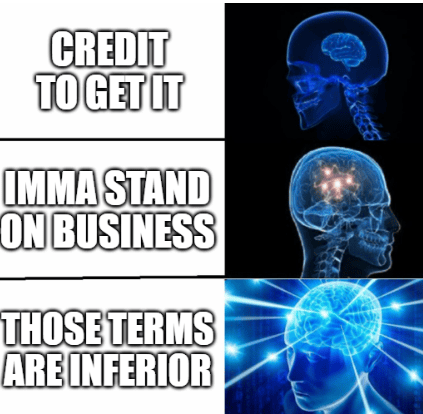
One of my first big deals I wrote back when I was an underwriter; I quoted a D&O/EPL/FID package for a new tech company at around $20k. Agent came back, “Lucas, we like working with you, but XXXX came back with similar terms at $12k. Anything you can do?”
I knew there weren’t enough credits in my arsenal to chase after $8k of premium. So I asked, “Would you mind sharing the quote I’m up against? If they’re offering the same thing at a better price, happy to admit defeat. But I’m curious if they’re offering everything I’m offering.”
I got the quote. Sure enough, there was a major shareholder exclusion. Now since I had the cap table I knew this account had 2 outside major shareholders. I called the agent back, “Look, their terms carve out this coverage. The reason I’m so much higher is because I’ve appropriately priced for this exposure. If they’re not interested in this coverage, then tell them to buy the cheaper deal.”
I won the deal.
That route took more work, I’ll admit. But I kept the rate and the premium, brought in more GWP, and I didn’t cave on price. If my actuaries are telling me we need to write at this rate to be profitable, then that’s what I’m going to write. And more importantly; my coverage was better. I had the Mercedes, but my agent didn’t know that I was offering a Mercedes, nor did they know the other carrier was selling a Ford Fiesta. But ultimately their client was in the market for a Mercedes, so that’s what we sold.
Fold On Price, Fold On Coverage
There’s one last devastating consequence for failing to sell coverage and capitulating on price; market sustainability.
Ok Mr. Wholesaler, why should you care about price? (I didn’t forget about you!) Because if you’re offering broader terms at cheaper premiums, then what happens when rates go up, or God forbid that account take a claim? If the coverage is broader, then obviously the likelihood of picking up a claim increases. And if you pushed to get the lower premium, then that carrier is going to get off the account asap. They have no reason to stay on. They’re out of rate on a deal that they now regret winning.
You won the deal for 1 year. Now it’s year 2 and instead of allowing your account to passively grow on your book, now you’ve got to remarket the account with hat in hand, begging for someone, anyone that offers similar terms and premiums to expiring. Then at renewal you find out another slick talking wholesaler swopped in. He found a carrier that offered “similar” coverage, and the insured didn’t realize they were leaving your Mercedes to hop into their Ford Fiesta. Having a little dignity and standing up for your carrier partners and their superior coverage might cost you in the short term, but it pays dividends in the long term.
That’s the part I think we’re missing in this equation; why should all parties care about pricing sustainability? If D&O policies sell for $4k regardless of what exclusions and carveouts are in it, then carriers will add the exclusions and write the business. The $8k policies with broader coverage don’t sell, so why should I bother? Then the wholesaler is put in an uncomfortable situation when the claim gets denied, fingers start getting pointed, and E&O carriers start getting put on notice.
It’s much easier to do the hard work right at the onset. Learn your forms. Find your good products. Speak authoritatively on the coverage you’re selling. Sell coverage, and sell it with sustainable pricing.
Underwriters, don’t let your wholesaler push you in price, then ghost you when the newer, cheaper carrier comes to town.
And Wholesalers, don’t always sell price. You’re not Wal-Mart. You’re a Claims Made insurance professional. Have some self respect, find the coverage gaps, and stick with your carrier’s price, especially if their coverage is better than the competition.
We’ll let the insured decide between price and coverage. But let’s stop pretending the products we sell compare like apples to apples.
Until next time agents, stay bindin’ and grindin’.
Meet the Author
 Lucas Roberts
Management Liability Broker, Burns & Wilcox
Executive and professional lines specialist with experience in both underwriting and wholesale brokerage.
Publishes on claims-made coverage mechanics across three channels:
- LinkedIn— Regular commentary on coverage developments
- Claims Made Bites — This column on PLUS Blog
- 0omissions.com — Blog about coverage gaps in the claims made industry
The information and opinions expressed by the author are their own, and do not necessarily represent the views of their employers or of PLUS. The contents of these materials may not be relied upon as legal advice.
News Type
PLUS Blog
Business Line
Professional Liability
Contribute to
PLUS Blog
Contribute your thoughts to the PLUS Membership consisting of 45,000+ Professional Liability Practitioners.
Related Podcasts

Icons & Innovators Episode 4
In this episode, Michelle Klein of Berkley Professional Liability sits down with…
Related Articles

From Foundations to Emerging Risks: Inside D&O University
The D&O liability landscape continues to evolve, making a strong understanding of…

Claims Made Bites: Claims Made vs. Claims Made and Reported
Two similar-sounding policy forms with an important difference. One leaves the door…

2026 Mid-Year Management Liability Claims Update – Emerging Risks and Lessons for Insureds
As we pass the midpoint of 2026, management liability risks continue to…